
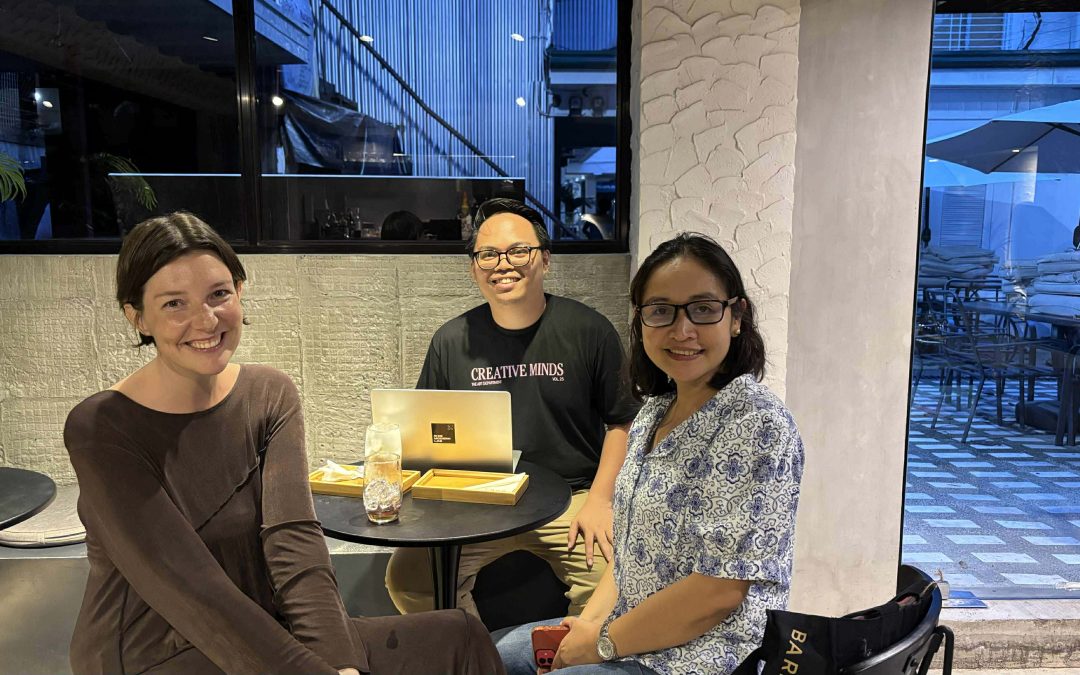
Photo: Taylor Mitchell (Columbia University), Fidel Laurence Ricafranca, and Asst. Prof. Crina E. Tañongon (UP Cebu) during a project meeting in Cebu City.
The Central Visayas Studies Center (CVSC) of the University of the Philippines Cebu has forged a meaningful collaboration with the Center for Science and Society (CSS) of Columbia University for a project titled Restoring/Restorying: Sugbo Seed Archive. This initiative bridges research, art, and community knowledge to combat food insecurity and climate change by revitalizing traditional food systems in Cebu, Philippines.
The project brings together three collaborators: Taylor Mitchell, Graduate Student in Sociocultural Anthropology at Columbia University; Dr. Crina E. Tañongon, Director of CVSC (January to November 2025) and faculty member of the Communication Program at UP Cebu; and Fidel Laurence Ricafranca, website developer and designer. Together, they are building a bilingual (Cebuano and English), community-driven digital platform that documents Cebu’s food heritage, heirloom seeds, cuisine, and sustainable farming systems.
At the heart of this collaboration are the community organizations in Cebu such as Communities for Alternative Food Ecosystems Initiative (CAFEI), Slow Food Sugbo, Cebu Seed Savers (CSS), and Native Tree Advocates Inc. (NATAD) that have long been working to challenge food insecurity and the climate crisis by advocating for alternative and regenerative food systems. These groups, comprising farmers, seed savers, and advocates of local biodiversity, serve as the project’s key partners and knowledge holders. Yet, to date, no systematic research has documented their collective efforts in revitalizing traditional methods of food production, supply, preparation, and consumption, including allied ecosystem services such as heirloom seed preservation and the reforestation of degraded areas with native trees. The Sugbo Seed Archive seeks to change this by co-creating a shared digital space that celebrates, protects, and transmits their knowledge across generations.
The Sugbo Seed Archive aims to preserve and amplify Cebu’s agrarian wisdom by documenting Indigenous food practices through art, poetry, and research. It will feature a digital library and multimedia materials on native planting and heirloom seed saving. The archive will also curate essays, poetry, and reflections from Cebuano writers, scientists, and farmers, alongside academic research on seed sovereignty and agroecological resilience—translated into Cebuano to ensure accessibility for local communities.
This partnership underscores CVSC’s commitment to interdisciplinary, community-based research that integrates the humanities, communication, and environmental science. By restorying local food cultures and restoring Indigenous practices, the Sugbo Seed Archive envisions a resilient and sustainable food future for Cebu and beyond.
The concept of “Restorying and Restoring” in this project is inspired by the Living Story Landscapes initiative led by the Green Releaf Organization based in Cebu, under the leadership of Sarah Queblatin, a regenerative design specialist. This Philippine-born framework has been instrumental in nurturing regenerative storytelling and place-based approaches to healing landscapes and communities.
In line with the United Nations Sustainable Development Goals (SDGs), this collaboration advances global efforts toward achieving food security and sustainable agriculture (SDG 2: Zero Hunger) by promoting the revitalization of local and Indigenous food systems. It also supports responsible production and consumption (SDG 12) by preserving traditional farming and food heritage practices, and contributes to climate action (SDG 13) through biodiversity conservation and ecosystem restoration. Further, the project aligns with the protection of terrestrial ecosystems (SDG 15: Life on Land) by promoting reforestation and native species preservation, and embodies the spirit of partnership (SDG 17: Partnerships for the Goals) through the synergy of academic institutions, local communities, and global collaborators working toward a shared vision of resilience and sustainability.